

As artificial intelligence becomes more applicable in Health care, home-based care providers are finally diving into use cases that may work for them.
The Brentwood, Tennessee-based Compassus is a prime example of that. A forward-thinking provider, it has been utilizing RPM and telehealth for years, even prior to COVID-19.
Now, it’s looking at ways it can fit AI into its operations.

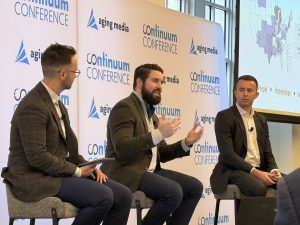
“We currently have a couple of work streams right now — one being for clinicians — around how AI can make their job and role easier or better,” Compassus COO Laura Templeton said during Aging Media Network’s Continuum conference recently. “We’ve been looking closely at how to consolidate and optimize processes by utilizing AI tools.”
Compassus provides home health, hospice, palliative and home infusion services across more than 250 locations in 29 states. It is backed by the private equity firm Towerbrook Capital Partners and the health system Ascension Health.
Templeton believes that, in the future, AI could make a meaningful difference in two areas for Compassus: documentation and scheduling. “We’ve piloted several scheduling programs where we’re using our clinicians at the top of their license, and where we are sending the right clinician, at the right time, to the right place,” she said. “Scheduling is one area that comes to mind where I’m excited to see what AI can do.”
Compassus envisions AI playing a pivotal role in areas that inherently require human intervention. Examples include documentation, narrative summaries and coding, according to Templeton. But there are still hurdles to work through.
“Clinical documentation has always been a big one — which has a lot of different layered potential use cases,” Jordan Holland, the VP of value-based contracting at Compassus, also said at Continuum.
“There’s the idea of talk-to-text, but then there’s also talk-to-text to other discrete fields. Talk-to-text is great, but is that actually going to help you facilitate filling out an OASIS form? There’s an added layer to that because that talk-to-text then gets submitted to another party.” AI needs to be utilized responsibly, a fact all health care executives will mention when touting it. But, at the same time, it can also help providers become more compliant.
“One good use case for AI is taking clean data and then continually monitoring and driving insight from that data that changes what you do upstream,” Holland said. “So, on the compliance side, where you are seeing some of these audits — AI can show you what’s driving any sort of audit-related activities and then how you actually prevent some of that more upstream. I think there’s a lot of applicability there. I would still put that in almost a sub-layer of clinical documentation opportunities.”
Finding partners
As AI slowly infiltrates home-based care, it’s important to find the right technology partners and to be on the same page about what capabilities are most worthwhile to pursue.
“As we know, there’s a lot of vendors out there,” Templeton said. “Picking the right partner for you to innovate and create together has been something that I feel like we’ve done a nice job of. You have to listen to the needs of the customer and come together on what you’re trying to solve for. Everybody in our space has constraints and pressures on wages, caregivers, turnover — so if you’ve got that partner that is seeking similar goals and objectives, then you can align with that partner.”
Looking ahead, Compassus is also focused on establishing and maintaining partnerships with other risk-bearing entities to create interoperability across the care continuum.
“We’re focused a lot more now on how we create that interoperability with other risk-bearing entities and with health systems,” Holland said. “On the health system side, a lot of that is, ‘How can we create lean-in opportunities to help solve each other’s challenges?’ I think there’s a lot of technological opportunities for solving health system problems with better post-acute collaboration.”
Click here to view the Home Health Care News article.
