


When JJ, a Golden Retriever therapy dog, climbed into bed with a comatose hospice patient who was alone in the world and in her final hours, a little miracle happened. As JJ gently nuzzled and licked the patient’s unmoving hand, it began to respond, first with tiny, almost imperceptible, movements. JJ encouraged the faint response with more nuzzling and received what would be the patient’s final act — tender caresses to JJ’s soft, furry head. Tracy Calhoun, a hospice nurse, caught the poignant moment between her dog and her patient with a camera phone and posted it on JJ’s Facebook page. The video quickly went viral and it has been seen by millions worldwide.
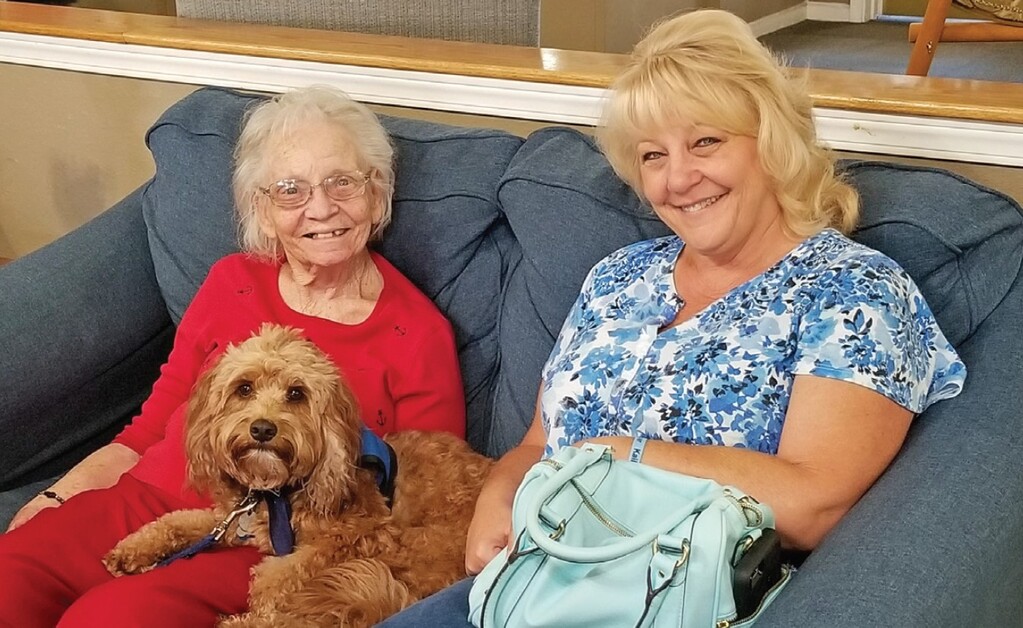
The idea of bringing animals into a medical setting hasn’t always been a welcome idea. But when a Denver hospital began allowing therapy dogs for ill children in the mid-1980s, the tide began to turn, Calhoun says. “It made such a huge difference, and the staff could see that,” she says. As dogs have been elevated to family status and migrated from the back yard to the living room, their therapy counterparts have been welcomed into schools, libraries, nursing homes, hospitals and hospice settings.
How Does Animal-assisted Therapy Help?
Animal-assisted therapy has been shown to reduce anxiety, pain, depression, fatigue and stress in both medical and non-medical situations, according to the Mayo Clinic. Not only does pet therapy help in symptom management, it also boosts patients’ well-being. “There’s just something real when you touch an animal,” she says. “It’s calming and lowers your stress level and blood pressure.”
Calhoun has been a pet therapy advocate for decades. Indeed, as a hospice nurse in the mid-1990s, she arranged the first hospice visit in Washington state by therapy dogs. “Dogs live in the moment, and they bring you to the moment,” Calhoun says. “Even if it’s just for two or five or 10 minutes, they make you forget what’s going on, whether it’s sadness or anticipatory grief. Spending time with this unconditional love is a huge, huge benefit.”
“There are times when, as a nurse, there are no words to comfort a patient or family … but there were times when JJ would go and seek out those who needed her the most,” Calhoun says. “With heavy grief, dogs can lick away the tears or put their head in someone’s lap.” Even if a patient doesn’t want to interact with a therapy dog, the animal’s mere presence can create a homey atmosphere, adding to the patient’s quality of life, she says.
Four-legged friends
Registered therapy pets can include cats, rabbits, baby goats, miniature horses and even potbellied pigs, but generally, they are dogs, Calhoun says. Pet therapy is safe and secure for patients because therapy animals are clean, vaccinated, screened for temperament and well-trained to gently interact with those who need them. “Therapy animals go out into the world just to be loved on and bring comfort,” Calhoun says.
Pet therapy can be as helpful for family members as for hospice patients, Calhoun says, recalling one of her patients — a man in his 30s with a brain tumor — who had moved in with his parents after diagnosis. While her patient enjoyed the visits from Calhoun’s therapy dog, Callie, his parents joyfully embraced the gentle dog to the point they bought a big box of dog biscuits to treat her each time.
“I can remember the dad’s expression; he just loved spending time with her,” she says. “That respite — having her around for half an hour, petting her while I was doing my thing — was so nice for them.” “It doesn’t take away from what’s going on,” she adds, “but it gives a brief little respite from the sadness around you.” Besides being part of her professional life, animal-assisted therapy is also deeply personal to Calhoun.
“When my mom was on hospice in Montana, they would bring in baby goats. She had ALS (amyotrophic lateral sclerosis, a progressive neurodegenerative disease also known as Lou Gehrig’s disease) and was losing some of her motor movement,” Calhoun says. “But when they brought in the baby goats, she had a big smile on her face.”
“There’s just a magic about animals.”
